
Ewenki customs ewenki holiday information and clothing characteristics
The ewenkiCustoms and habitsEwenki holiday information and clothing characteristics
The ewenki nationality people are mainly distributed in northeast China's heilongjiang province NeHe county and the Inner Mongolia autonomous region.The ewenki nationality is a nationality, which means "the people who live in the mountain forest".A population of 30505 people (2000).Have their own language for the ewerki but no words.The ewenki nationality belongs to the altaic language - the tunguska languages full tunguska dialect.The present most herders use Mongolian, farmers are widely used in Chinese.
Ewenki oral creation myths, stories, songs, riddles, etc., are also good at using birch bark engraved cut into all kinds of arts and crafts.Most of the ewenki nationality people make a living by grazing, the remaining engaged in farming.Reindeer was owenk people the only means of transportation, is known as "the boat forest".Ewenki believed in shamanism and Buddhism.Main festivals are the aobao, lunar and meters wide section.
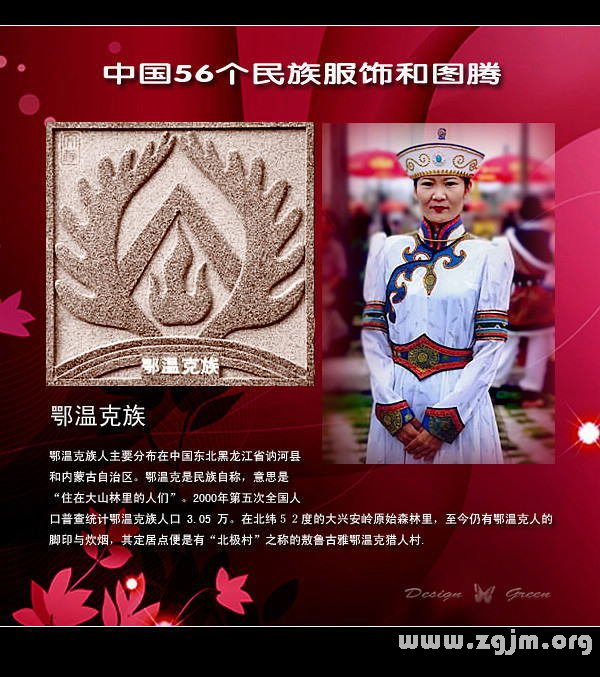
The name of the ewenki origin
In the history of the ewenki due to steep constantly moving and living scattered, combined with the traffic inconvenience, intercommunion, less in isolation, gradually formed a regional economic and life slightly different;Had been other nationalities respectively referred to as the "solo", "remote", "yakut", "horne Kerr", "Carlisle wood NiKan", ", "and so on.In fact, the part of the humanism is a nation, they have a common language and customs, only there are some differences in production and living.The largest number of such as being referred to as "sauron", about twenty-three thousand people, located in hui river, the min river, mo and figure, elegant rhue, and la river dawen river, arun river, Allegheny river, NuoMin river, ganhe, oil desert river basin.This part of the ewenki nationality people engaged in hunting industry and animal husbandry and agriculture and hunting for a living, some people once engaged in agriculture;Called "tunguska" two people, living in mo day he river, tin river shelter-forest region, they mainly engaged in animal husbandry;Referred to as "yakut" part of the people, living in erguna river and bear river (now torrent river) valley of primitive hunting in the forest and raising reindeer for a livelihood.
Ewenki people in history never admits that he is "solo", "remote", "yakut" and so on, they are traditionally claimed to be "the present".However, their wish to restore the nationality, in the past dynasties ruling class under the system of the national oppression, never became reality.After the liberation, the party and the people's government according to the ewenki people's desire, the surveillance, minorities affairs committee (expand) meeting has a special organization their representatives discussion "solo", "tunguska" and "yakut" name of ethnic problems, and organize the general public to families of the ewenki said problems widely deliberation and discussion.They cited a large number of facts that humanism is an ethnic group, three parts of ewenki is out of question.The people's government according to the requirements of their consistent restored the original real name - the present.
The religious beliefs of ewenki
Ewenki most beliefs shamanism, pastoral areas some Tibetan buddhist faith.Worship ghosts and gods, the worship of nature.Habits are mainly animal worship, totem worship and ancestor worship.Practice the celestial burial (i.e., the wind was buried) in the past, then how to burial.Main festivals are the aobao, lunar and meters wide section.
Ewenki diet
The pure animal husbandry production area of ewenki is staple food with milk, meat, noodles, daily meals can't leave milk tea, not only for milk tea drinks, also often think of milk tea is processed into yogurt and milk products.Main dairy products: milk cream, butter, milk residue, dry and creme.The most common way is to extract the butter on the bread or snacks to eat.
Meat is given priority to with beef and mutton.In the past every every year on average, eat 20 to sheep and two cows.Before the arrival of winter is the season of ewenki a large number of livestock slaughter storage of meat.Carnivorous method: hand, black pudding, boil the meat meat rice porridge and kebabs.
Live in the greater hinggan mountains in north of ewenki in the primitive forest, completely is the staple food of everyday life with meat, rarely reach An meat meat, deer, bear, wild boar, roe deer, squirrel meat, pheasant, chicken, fish, etc., and dragon to eat it with a slightly different pastoral areas, including An of Abraham, deer, roe deer, liver and kidney are generally raw food, other parts are cooking.
Fish for stewed, boiled fish just chrysanthum and salt, exquisite broth, flavor.Ewenki seldom eat vegetables, only collect some chrysanthum, pickles, as a side table.Since the early 1950 s, the staple food is noodles, such as: noodles, pancakes, steamed buns, etc.
Ewenki with milk tea to drink, drink according to personal taste when add butter, milk residue.In addition, drinking seasoned millet mush, meat, tea.Forest region of ewenki also drinking the local characteristic of the reindeer.
Ewenki traditional ChuiCan appliance distinctive, useful for An bone made of glass, chopsticks, a small handleless wine cup made of antlers, An son belly of boiled meat, rarely reach An jin sewing deerskin shing food bag, birch, various leather bowl, dish, etc.Now porcelain, aluminum, iron, plastic products have been widely used.
Ewenki are mainly distributed in northeast China's heilongjiang province and Inner Mongolia autonomous region.The present means "people who live in the mountain forest.Most of the ewenki nationality people make a living by grazing, the remaining engaged in farming.
Have a mealAround the fire, the family sit on the floor in a tripod hanging POTS, will capture the moose or other prey cut into pieces, into the boiling pot rinse of roll.Rinse the meat out more with whereas bloodshot, half a lifetime half ripe.People think that eating is not only rich nutrition, and easy to absorb.
The rest of the a lot of meat, the present article drying into dried meat and meat, stored eat slowly, when go out hunting, put it in deer package pocket when dry.
Ewenki festivals
Ewenki festival mainly has the aobao, lunar and kuo, "" section and Mr Penn quarter, etc.To cattle and sheep for slaughter sacrifices offering aobao, pray for the people and peace.Aobao also at the meeting held every time the horse racing, wrestling and other activities."Rich," section is the production of festival, every year a summer held on May 22, the day to give the horse brand, shear mane, castration, in addition to the bad tooth, shearing the sheep ear mark, etc., and held a party.Mr Penn is a year of June 18, "Mr Bean" is the ewenki language, meaning "happy".Mr Penn quarter is ewenki traditional festival, the day people will be dressed in costumes to the party, hosted by the emirates to holiday, holiday filled with rob silver bowl, rice, dry car, horse racing and other sports.There are people with a special focus on the worship of vulcan, ancestor worship ceremony, after singing and dancing around a bonfire.
In addition toThe Spring FestivalSuch as festival and other national holiday nearby, ewenki characteristic each year in the lunar June 18 Mr Penn quarter and a date in late may to section "rice lu"."M" lu is celebrating a good harvest.During the festival, people dressed in costumes, men need to cut horsehair, horsetail, when herdsmen every family to arrange another wonderful wine meat, fete relatives and friends.
Meters wide shandong section of the hulun buir grassland mo erg river basin in the present herdsmen's harvest festival.Every year on mid to late may, busy JieGao beaming BaoChu owenk people gathered together, celebrate the annual harvest festival.
Meters wide section for a series of production activities, mainly to ma brand, in addition to the bad tooth, cut down, cut mane and to the lamb cut potential, etc.Firstly, "Moore" (i.e., grazing cabal) of a head start, first set out from the herd horse, two down, some people use scissors mane and tail tip, cut someone with a knife to cut the ear as signs.When the owner of the horse of their livestock burn, red seal in the horse's left up.Cut off the mane raised by the client, the ear of the cut piece of points by the client to save.In a shed, ewes went out to eat grass and leaves had a little lamb, full circle grazing people cut male lambs potential (castration village pill), the female lamb ears cut out their own style of gouges where whole pieces were missing (each sheep gouges where whole pieces were missing is not the same, in order to show the difference).
Meters wide festival, old people also gave their loved ones (e.g., nephew, my nephew, daughters, etc.) the female lamb, best wishes to the younger generation has more sheep.Finally, various plastic a banquet.At the beginning of the party is usually based on the ewenki nationality wine habits after tea first.Toast, inch, beginning from the chief, namely by the men and women master holding a wooden tray, put two glass plates, in turn to let.Master toast when the wheel a week to produce a "hada" to cut the potential man, on the same day "solemnly tell everybody New Year breeding for assistance.Everyone wishes to congratulate his master, his cattle, brand cut the number of potential increases with every year.
Ewenki customs ewenki holiday information and dress characteristic related content:
- The habits and customs of the miao miao festival information and clothing characteristics
- Tujia customs information and dress characteristic tujia festivals
- The customs of yi yi holiday information and clothing characteristics
- The habits and customs of the Mongolian Mongolian festival information and clothing characteristics
- Tibetan customs and habits of the Tibetan festivals data and characteristics of the clothing
- The custom of the buyi buyi holiday information and characteristics of the clothing
- Yao yao nationality customs and traditions of the holiday information and characteristics of the clothing
- The Korean customs Korean festival information and clothing characteristics