
What are the han nationality traditional festival
What are the han nationality traditional festival
The han nationality in China is undoubtedly a famous big people.A long history, rich culture, the humanities landscape is fabulous.The festival very much, the han nationality culture have celebrate Spring Festival, the Mid-Autumn festival, the tomb-sweeping day ancestor worship, 11 National Day, Lantern Festival and so on inundated with festival, festival of diversification, more can reflect the culture of the han nationality and profound.
The han Chinese people since the ancient times will have their own festival, some continues to this day, some are watered down gradually with the passing years.
Many han Chinese festival, main Greek festival, people,The Spring Festival, yuanxiao, club days, the tomb-sweeping day, dragon-boat festival and the Mid-Autumn festival, double ninth, and so on.In the festival, the Spring Festival is the most grand."The Spring Festival is also called" New Year's day, is the han Chinese to the most important traditional festival in one thousand, is the most popular and ceremonious festival of the year.When the New Year, New Year's eve to shou sui, the new moon to New Year.
Spring Festival customs of the han nationality, general to eat rice cakes, dumplings, zi ba, glutinous dumplings, Fried eggs, meat ball, whole fish, wine, tangerine produced in fujian province, apples, peanuts, melon seeds, candy, fragrant teas and YaoZhuan primarily;Accompanied by shan dust, wash the sheets, necessities, and stick couplets on the Spring Festival, followed god zhongkui (fight), paste paper-cut, stick grilles, stick to everyone, candles, point wood-pile,Set off firecrackers, shou sui, happy New Year, send New Year's money, relatives, rites, ancestral graves and going to the flower market, jan, dancing zhongkui, and many other activities, all happy.The habit of the Chinese Spring Festival and hang Chinese knot.Year before people have to ancient culture street in tianjin Qiao Xiangge please the custom of the Chinese knot, take Qiao Xiang fortune meaning;Wenzhou people have to go to their religious piety prayer, hope to be able to in the New Year, happiness together with family.Among them, the more to Buddhism.
Spring is han calendar (lunar calendar)The 24 solar termsThe first, also is the first day of spring, to signal the start of the year farming activities, has always paid great attention for the people of the han nationality, as early as the song dynasty, spring customs has very rich.
Also known as "the Lantern Festival", RMB has festival, in the first month, evening or Lantern Festival.Is one of China's traditional festival, also is the Chinese character culture circle area and one of the overseas Chinese traditional festivals.
Yuanxiao, meaning "the Lantern Festival evening", because of the Chinese calendar (lunar calendar) the fifteenth day of the first "is the Lantern Festival".The main activities are evening eat rice balls and enjoy the festival name later evolved into"The Lantern Festival".Will continue starting the New Year's eve celebrations to another climax.Yuanxiao nights, streets decorated, people watching lanterns, guess riddles, eating lantern, become a custom of generation down.
Clubs of the ancients club god worship festival day.From the right to all the people will make social horses to sacrifice.According to the rites. The offerings of righteousness, the son of heaven for all the people always state news agency said "too club, club called" Wang She "stands for oneself;Governors for sealing the domestic people always state news agency said "country club", stands for oneself the club called "Hou She";Under the doctor for his club, but joint of the people in the city set up a club, said the "club".So that all over the country have their own people sacrifice for officials.
Dragon head: also known as neutral section."At the age of yanjing record" said: "on February 2, the ancient and section, also call today for the dragon looked up."The feast on the east black dragon seven night at the position in the sky.Look from astronomical phenomena, whenever the spring equinox, the dusk spica in east horizon, and the other six nights is hidden below the horizon, therefore the dragon looked up.
The summer solstice, black dragon seven lodge is located in the south, the spring equinox hidden under the horizon until after the coming year.Therefore, said wen jie zi "interpretation of the dragon" vernal equinox and heaven, autumnal equinox and dive deep."Due to the balance of Yin and Yang, heaven and earth dowa day of the year only spring equinox, the autumnal equinox, called the neutral section, autumnal equinox and section of saidThe Mid-Autumn festival, and section of the vernal equinox is the Spring Festival.Future generations will be fixed in the lunar August 15 Mid-Autumn festival, is also called the six February 15 HuaChao festival, moon spring flowers, the corresponding perfect.Due to the dragon head, people always worship the dragon, pray for good.
Shangsi festival is a festival in han people's.According to the usual, han times in early march before the third day, wei after fixed for the Chinese calendar (lunar calendar) on March 3, for the third day.
The Dragon Boat FestivalAlso called DuanYangJie, ChongWu section.Since the han dynasty as the fifth lunar month, today, to become China's traditional folk three big one of the festival (the Spring Festival, Dragon Boat Festival, Mid-Autumn festival).
Northern and southern dynasties, the Chinese valentine's day and development for women the needlework strives for the holiday.One day in the evening, every household cleaning the yard, women cloth feast in court, descending vega, beg god bless their ingenuity.How to determine whether coincidence?catchThe spiderIn a box, the next morning, spider silk more densely so that more.Needle is also a method for month.Needle for special five holes, 7, 9 hole hole needle, thread so rapidly through the take over.
Such as tang dynasty poet 祖咏 "Tanabata" : to needle is easy to the moon, the breeze the whole line is difficult, I do not know who ingeniously, Ming Dan give it a try., and a method for the needle in birdbath, needle floating of the water, the projection in the pelvic floor, "successful cloud, flower heads, birds and beasts who, have shoes and scissors, water, tomato's panhandle coincidence."(" the emperor jing scenery slightly ") at the same time, every household to do "the needlework fruit", to oil, noodles, sugar, honey, oven baked or Fried, face as qiao, glutinous rice as a powder.Conditional the somebody else will take "the needlework tent".
Hungry ghost festival, commonly known as "Halloween", legend is hell opens, the ghost sovereigns, there folk proverbs yue "scurrying about in July and a half, ghosts".Have si son home by worship, no si, everybody please buddhist practice, don't make the stray.To say the hungry ghost festival for the dead in ancient China.
The Mid-Autumn festival is also called, the mid autumn festival, the moon and the Mid-Autumn festival, the moon festival, chasing, worship, the mid autumn festival, is popular in many national and traditional culture festival in east Asian countries.In traditional calendar, every season can be divided into "meng, zhong, season" for three months, han calendar (lunar calendar) on August 15, just half of autumn, hence its name.
The Mid-Autumn festival has a long history, and other traditional festivals, is also developed slowly.The ancient emperors have appeared in spring, autumn ritual ceremonies.The Mid-Autumn festival is derived from the ancient the offering of the month.The month circle person and reunion, expressed the Chinese people in the round circle month of countless good wishes.
The double ninth festivalAnd weighing nine sections, tread "autumn", the han nationality traditional festival.In the Chinese calendar (lunar calendar) on September 9th.Because of theThe I ching"In the" six "as the number of Yin," nine "as Yang number, September 9th, the moon and sun and Yang, October, so called chongyang, also known as the ninth day the ancients believed that a geely is a cause for celebration.The double ninth festival has a history of more than two thousand years.The origin of the double ninth festival, the earliest can be pushed to the spring and autumn period and the warring states period.The warring states period, chongyang has respected by people, but only in the emperor palace.
Lunar October in history is an important part of the month, it is not only a harvest rites and harvest feast was held ShiYue, determination is also the first time.In October, the former seems to be a month of both joy and sorrow.People day in October a dinner party drink, celebrating the harvest;A worship of ancestors, qi please ancestors of the shield and mentally prepared to spend the winter.Later October festival vulgar activity of in situ preach on the characteristic of the time people feel.
Modern people's view, the winter solstice is a solar term, but in ancient times, the winter solstice is not only a holiday, and is an important festival, winter solstice as big as a year. This day day short night long to the extreme, since the day it, gradually extend in a winter solstice sun, starts with the winter solstice is a method.
Before han dynasty, during the winter solstice to stop all work, think this day sun be the spirit rising, but very weak, try to minimize consumption. In addition, the rising sun be the spirit, the spring will come, and to celebrate. Since the wei and jin dynasty, the winter solstice, or the next day, the emperor would accept baiguan ChaoHe. MingZhengTong JiSi (civil) once abolished, back in the qing dynasty.
The laba festival, also called la festa, is China's ancestors worship our ancestors and gods (including bucket, door god, god, the god of kitchen god, JingShen) sacrifice ceremony, praying for harvest and auspicious day., according to the si ji jiao, features "records, la is the" age of December, and get together to share everything without cable also."Dynasty called LaRi jia ping, shang dynasty to the qing si ", the zhou dynasty as the "big wax";"La" instead of "wax" for han dynasty.Sacrifice object every 8: first increase after god - shennong, increase - millet, the god of agriculture kanda officer, mail table field god, fang, butch god, water agent, insects, god.
La festa of pre-qin period on the third day of the winter solstice after from han dynasty to the northern and southern dynasties gradually fixed in the day for la festa.After that, every laba day and to worship god preserved, folk tend to be prepared a speck of porridge.This porridge is made from grain mixed with peanut, chestnut, jujube, walnut meat, almond, cooked with micro fire boiled up, add brown sugar, made eight color sweet porridge, called "laba porridge".Porridge boil after, want to hold on a few first bowl, placed in the courtyard patio, grinding plate, horses and cattle on the door of the sheep pens, to show to celebrate a good harvest, auspicious meaning.
However people is a common custom of great river north and south.In the past, should be in on this day people ZaoWu (kitchen) on the wall near the stove top worship god, grandma wang oven.Both sides of the buddhist statues to affix a antithetical couplets, write "good" heaven, bottom allied write "some lower bounds or" auspicious "back to the palace drop, banners is" the head of the family ".The ancients cloud: "saying" claims, so people see the kitchen god respectfully as head of the family, this is completely understandable.
The han nationality festival customs.Popular in east sichuan area, western sichuan area.On the first day of a year, people rushed to the early bear well water, called silver water.Folk think: who bear the earliest backwater, who this year will be the most prosperous.Full cylinder silver water, symbol of financial resources into.In some places still use to take back to the silver water burn tea, to the main shrine, pray to god.
The han nationality festival customs.Popular in western sichuan area.Folk in the rain day, married daughter have to bring a gift back to visit his parents.Women, the child should bring cans of meat, chairs and other gifts, thank the parents' support.Long time nopregnancyWomen, by mother for its sewing a red pants, wear to close, it is said that such insurable children as soon as possible.The customs are still popular in the rural areas.
In the four major traditional festival day
The Mid-Autumn festival and the Spring Festival,The qingming festival, the Dragon Boat Festival is known as the four traditional festivals of Chinese han nationality.
China's four big traditional festival Mid-Autumn festival
According to history records, the ancient emperors have appeared in spring, autumn, ritual ceremonies, and the feast in the month as the lunar August 15, at the time of sowing and ploughing and a half, so the name "Mid-Autumn festival";And because of the holiday in the autumn in August, so it is also called "autumn festival", "the mid autumn festival", "August", "Mid-Autumn festival";And pray for the reunion belief and common activities related section, therefore, also called "the mid autumn festival", "sections".For the main activity of the Mid-Autumn festival is around the "month", so they are commonly known as "moon festival", "the moon and the", "chasing day", "play on day", "worship festival";In the tang dynasty, the Mid-Autumn festival is also known as "correct".About the origin of the Mid-Autumn festival, generally there are three: originated from the ancient worship of the month, the month under the custom of song and dance to meet and fall of ancient relic of the land.
The Mid-Autumn festival since 2008 as a national legal holiday.Country attaches great importance to the protection of intangible cultural heritage, May 20, 2006, the festival is approved by the state council listed in the first national nonmaterial cultural heritage list.
China's four big traditional holiday of tomb-sweeping day
"Ching Ming festival is one of the most important traditional festival in China.It is not only people's worshiping ancestors, honor ancestors of the festival, is also the Chinese nation RenZuGuiZong ties, but also a hiking outing, close to nature, to rush to the new spring ceremony."Said Dr Folklore ShiAiDong at the Chinese academy of social sciences.
As an important festival of sacrifice, tomb sweeping day for an outing, such as custom mainly comes from the cold and the shangsi festival.The cold is associated with the ancients cognition of the nature.In China, well after the rebirth of new fire is a kind of new transition ceremony, disclosed information is seasonal, symbol of the new season, new hopes, new life, the beginning of a new cycle.Then have a "Thanksgiving" means, more emphasis on the "past" nostalgia and thanks.
Two fire ban cold food offerings tomb, qing Ming ta-qing get take new fire.Before the tang dynasty, before and after the cold food and clarity is two successive but different theme festivals, the former nostalgic lament, which new nursing students;A Yin and Yang, a life interest, in close cooperation with the two relations.The fire is to a fire, the wu was born in order to save, this is well associated with clear and internal culture.Tang dynasty, the imperial court to order the customs of the form of folk grave fixed in front of the tomb sweeping day cold, because cold food and clarity in time are closely linked, cold food customs associated with the tomb-sweeping day, early grave from cold food postpone to the qingming festival.
In song dynasty, after the tomb-sweeping day and cold food gradually becomes one of the tomb-sweeping day will sacrifice custom, under the name of cold food.At the same time, the shangsi festival "shangsi spring having" festival customs are merged to the tomb-sweeping day.When he got to the Ming and qing dynasties, shangsi festival out of the holiday system, cold have largely vanished.The spring only one tomb-sweeping day.
"Ching Ming festival is the synthesis and sublimation of almost every Spring Festival, ching Ming festival customs also has the more rich cultural connotation."ShiAiDong said.Unlike other traditional large sections, ching Ming festival is a blend of "the solar terms" and "section of the common" comprehensive festival.The tomb-sweeping day is from the throttle line after the vernal equinox, the weather warms up, the full of vitality everywhere, people hiking outing, close to nature, it may be said to days, help to absorb the nature pure Yang qi, dispel cold and depressed mood, leisurely are beneficial to the health of body and mind.
Began in the tang dynasty, two juxtaposed with the tomb-sweeping day holiday, the different title respectively have four to seven days holiday.The song dynasty is the age of life growing urbanization, is an age of folk custom to develop in the direction of entertainment.In order to allow people to tomb-sweeping day, for an outing, specially stipulated business off for three days, wushu off for a day.The qingming festival on the painting "describe age is the clear picture.
Tomb-sweeping day and for an outing, it is two different cultural theme, slowly, after the song dynasty and was constantly have certain cultural meaning.People to worship their ancestors and the Chinese nation attaches great importance to the national character of the filial piety, ShenZhongZhuiYuan directly link, think gratitude, not forggestting qingming festival customs reflects the Chinese people's moral consciousness.Its cultural significance similar to the westThanksgiving Day.Tomb-sweeping day ancestor worship, mourning remember ancestors merits of activity, with the Chinese culture deep ancestor worship, has the profound relationship between the culture of filial piety, and the culture is the Chinese society for thousands of years to the backbone of the harmonious and stable development, help to set up between the ancient and present, our predecessors and the posterity harmonious intergenerational relations, and promote human, the harmonious relationship between human and nature, and this also is tomb-sweeping day the strong vitality of private foundations.
ShiAiDong introduced, along with the development of productivity and the evolution of social life, tomb-sweeping day earlier appeared by divine sacrifice to secular entertainment trend, the tomb-sweeping day the grave became the holiday time for an outing spring outing.Seasonal JiaMu for willow spring, work is clear with Dai Liu reveals the peculiar fashion.During the period of the republic of China, inserted LiuRi also once become "Arbor Day".But no matter how to development, memorial and worship is a Chinese qingming festival is the most important content.
"No matter from origin or from the rheological, we can induce the information of the qingming festival two symbolic meanings, one is grateful to commemorate, 2 it is' rush to protect the new '."
China's four big traditional holiday of Dragon Boat Festival
Fifth lunar month is the Dragon Boat Festival, English for Dragon Boat Festival, also called DuanYangJie, dolls, afternoon day Festival, may Festival, ai Festival, terminal five, five, summer day, the day of the Festival, bath Festival, qu yuan, poet Festival, etc.Side is "start", the meaning of "early", the fifth can be referred to as the terminal five, and the Spring Festival, ching Ming festival, the Mid-Autumn festival is known as the four traditional festivals of Chinese han nationality.Lunar calendar in gan ji month, on the building day Yin, February as bases, in order to for the afternoon of may, so called in May for the sixth month, "five" and "afternoon", "five" again for Yang number, so some places may festival called the Dragon Boat Festival, ai festival, summer day.Look from the joseon dynasty, "dragon boat" two characters can be found in the earliest western one week "and" : "midsummer dragon-boat festival, boil 'rice dumpling".The Dragon Boat Festival is our traditional festival of the han people, this day indispensable activity gradually evolved to eat zongzi, dragon boat racing, hanging calamus and wormwood, folium artemisiae argyi, rhizoma atractylodis, radix angelicae, drink realgar wine, hundred suozi, do the slot, against the ruling, stick operator, rust-worn gears flaking, eat twelve red.It is said that eating zongzi and dragon boat racing, is to commemorate qu yuan, so after the liberation has the Dragon Boat Festival entitled "poet's day", in order to commemorate qu yuan.As for hanging calamus, folium artemisiae argyi, rhizoma atractylodis, radix angelicae, drink realgar wine, stick operator is said to be in order to ward off evil spirits."Ruling", central jiangsu with leek, Jiao grass (or lily flower), black fungus, silver fish, shrimp Fried, about is the symbol of this a few vegetables toad, scorpions and spiders, snakes,The centipedeSuch as ruling are essential food of the Dragon Boat Festival, now rare.But in northern shandong southern jiangsu with chili green ginger garlic parsley five have something exciting mix together the speculation is also called the ruling, general restaurant can point to the vegetables, because the ingredients are more common.Today, Dragon Boat Festival is still a very popular among the Chinese people, the grand festival.Since 2008 as a national legal holiday take a day off.Country attaches great importance to the protection of intangible cultural heritage, May 20, 2006, the folk have been approved by the state council listed in the first batch of state-level non-material cultural heritage list.On September 30, 2009 in the uae capital ABU dhabi at the United Nations educational, scientific and cultural organization to protect intangible cultural heritage committee meeting between the government decision: Chinese Dragon Boat Festival is successful in the world human intangible cultural heritage representative work list ".
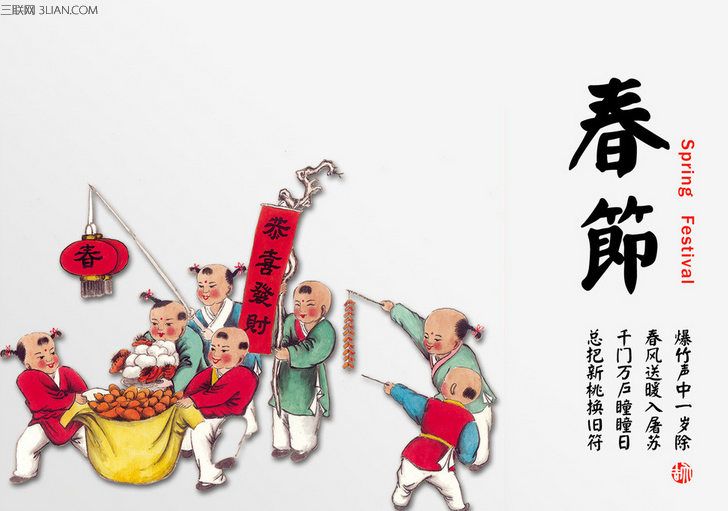
China's four big traditional holiday of the Spring Festival
Refers to Chinese traditional culture on the lunar New Year Spring Festival, the traditional name for the New Year, New Year, New Year, but verbally, celebrates the New Year, New Year's day is also called the degree of years old, old used specifically to throttle the spring begins in the Spring Festival, is also viewed as the beginning of the year, to the first lunar month later start for the New Year, it is generally believed until at least the fifteenth day of the New Year, the Lantern Festival is over, New Year's celebrations in some places even until the end of the first.The Spring Festival and the ching Ming festival, duanwu festival, Mid-Autumn festival and called the four traditional festivals of Chinese han nationality.
The Spring Festival is the most distinctive Chinese folk ceremonious traditional festival, is also the most busy an ancient festival.Generally refers to New Year's eve and the first day, the first lunar month is the first day of the year, also called the lunar year, commonly known as "Spring Festival".But in private, in the traditional sense of the Spring Festival is from the Greek festival of the day or month, 23 or 24 people, until the fifteenth, among them with New Year's eve and the first day of the first lunar month.During the Spring Festival, China's han and many ethnic minorities have held various activities to celebrate.These activities are to worship deities, worshiping ancestors, blow away the cobwebs, meet jubilee blessing, pray for good harvest as the main content.Rich and colorful activities with strong ethnic characteristics.Celebrate the Spring Festival in tianjin and the habit of hang Chinese knot, year before people in tianjin to tianjin ancient cultural street Qiao Xiangge please the custom of the Chinese knot, take Qiao Xiang fortune.
The Spring Festival is the most important festival in the han, manchu, Mongol, yao, zhuang, white, mountains, hezhen, hani, daur, dong, li and other dozens of ethnic minorities have the custom of Spring Festival, is each has its own national characteristics in the form of the feast.
The Spring Festival different times have different names.Prior warlords call "day" and "ganjitsu, age of" change ", "age" offer ", etc.;In the han period, and was called as "dynasties", "old Dan", "discussion", "twilight";Wei jin southern and northern dynasties was known as the "magic", "ganjitsu", "head of state", "age", etc.;In the yuan and Ming tang and the song, is known as the"New Year's DayAge ", "yuan", "day" and "up" and "s" and so on;And in the qing dynasty, has been called "New Year's day" or "ganjitsu".
- The last:South Korea what are the traditional festivals
- The next article: no